Root, fill and cap in one station
Full-penetration passes on box columns and H-sections, welded by the robot pass after pass.
 STEEL WELDING ROBOTS
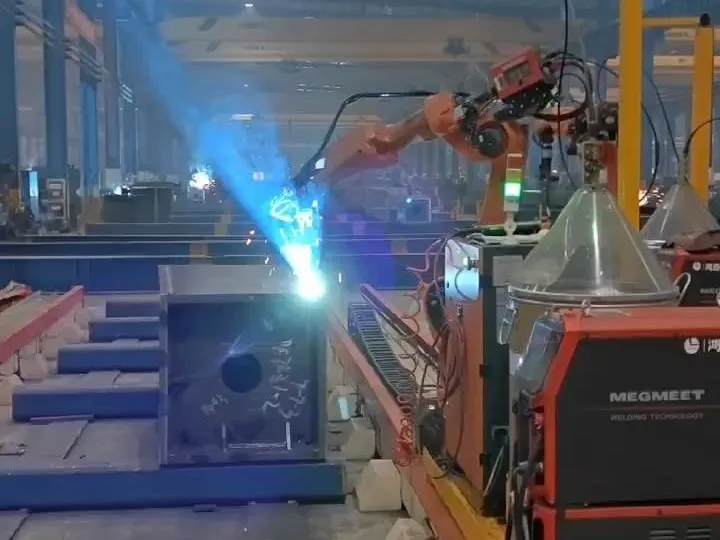
Submerged arc welding robot
Full-penetration welds on box columns and heavy H-sections need root, fill and cap passes. Our rail-mounted submerged arc robot welds all three, following the joint with real-time seam tracking.
Available with a single or twin wire. Built by a structural steel fabricator whose own plants run 2,000+ of our welding robots.
Standard configuration. Final specifications are confirmed in the quotation.
Full-penetration passes on box columns and H-sections, welded by the robot pass after pass.
The vision system follows the joint dynamically throughout welding.
Constant-current and constant-voltage modes, with weld pool stirring to improve penetration and bead shape.
Import a 3D model or build one by scanning; the software extracts the welds, plans the path and checks for collisions.
The station is built for long, heavy full-penetration seams in structural steel:
For fillet welds on stiffeners, corbels and cleats, the gas-shielded 7-axis robot is the better fit.
Standard configuration of the submerged arc station.
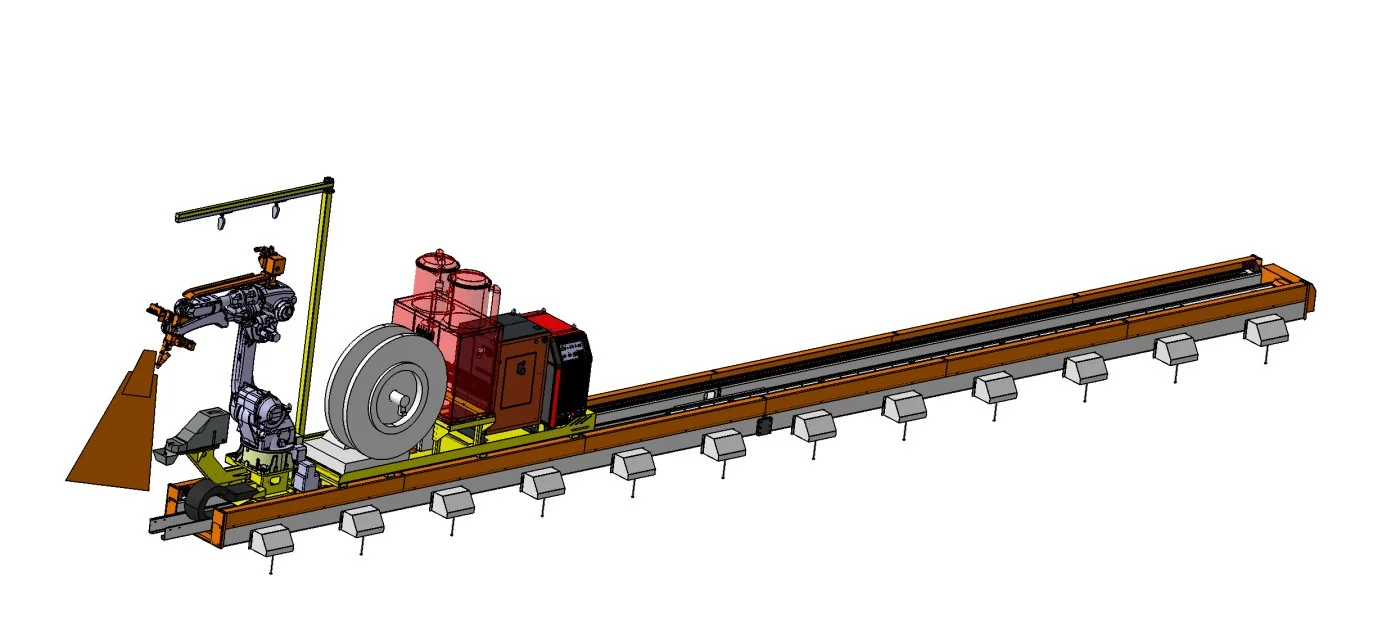
Values can vary with the station configuration. Final specifications are confirmed in the quotation.
| Item | Submerged Arc Welding Robot Station |
|---|---|
| Welding process | Submerged arc welding (SAW) |
| Versions | Single-wire or twin-wire |
| Typical welds | Full-penetration root, fill and cap passes |
| Workpieces | Box columns and H-sections |
| Robot payload | 50 kg |
| Robot reach | 2,000 mm |
| Power source | 1,250 A, 100% duty cycle, CC and CV modes |
| Seam tracking | Real-time dynamic tracking throughout welding |
| Rail length (standard) | 12 m |
| Effective travel (standard) | 10 m |
| Programming | 3D model import or reverse modelling; automatic weld extraction, path planning and collision checking |
| Material | Carbon structural steel |
Place the box column or H-section beside the rail.
Import the 3D model, or scan the part and let the software build it.
The software extracts the welds, takes parameters from the process library and checks the path for collisions.
The robot welds root, fill and cap passes while the vision system tracks the seam.
Both versions run on the same rail-mounted station. The twin-wire version feeds two wires into one weld pool, which raises deposition on thick sections.
Tell us your plate thicknesses, joint preparation and weld volume, and we recommend the version that fits.
Describe your box columns or H-sections, plate thicknesses and joint preparation. Drawings are welcome but not required to start.
Prefer email? [email protected]
Common questions about robotic submerged arc welding.
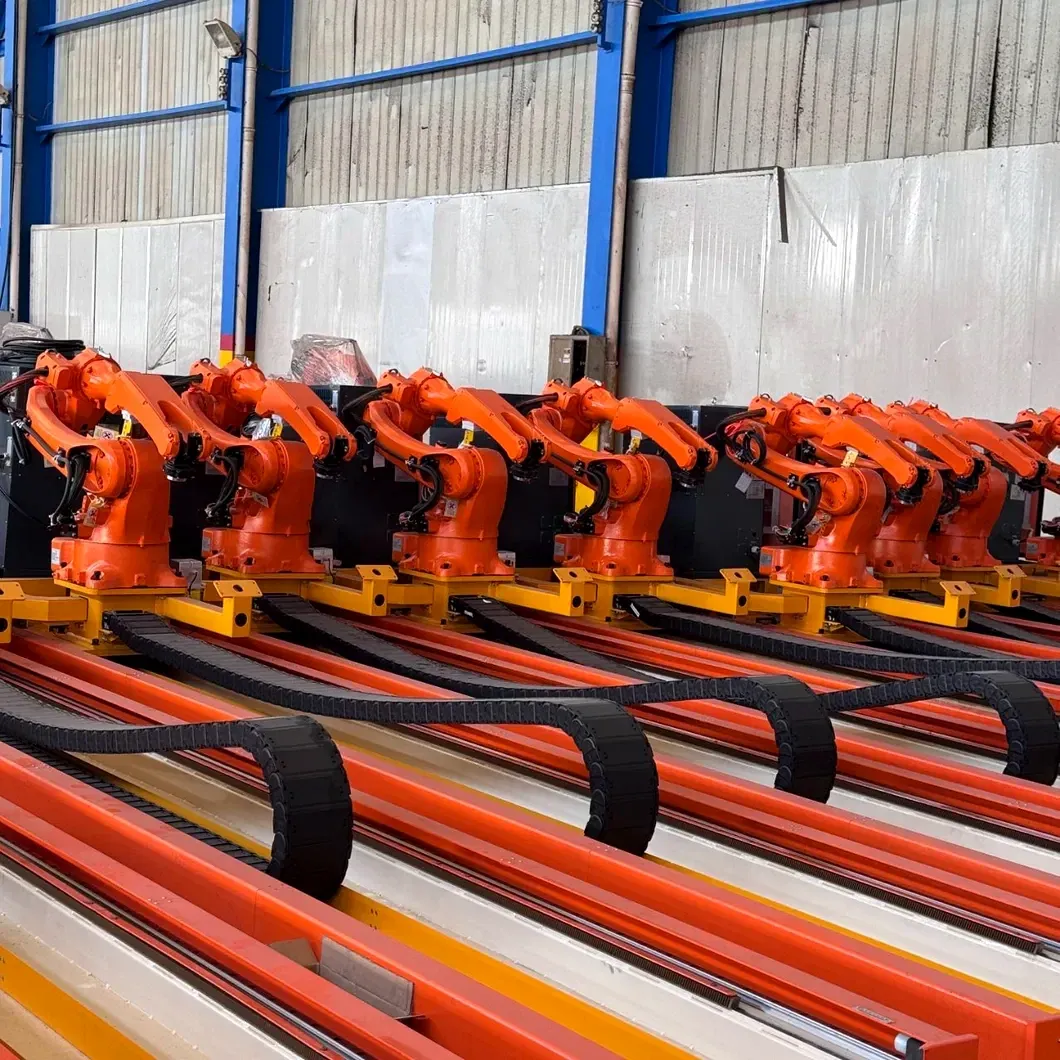
A robot that carries a submerged arc torch: the arc burns under a layer of flux, which suits long, heavy, full-penetration seams. On our station the robot travels on a 12 m rail and tracks the seam in real time.
Twin-wire raises deposition on thick sections. Send us your plate thicknesses and volumes and we recommend the version that fits.
It can import a 3D model or build one by scanning the part. You do not need a model to send a first inquiry.
Yes. The SAW station takes the long full-penetration seams, and the 7-axis gas-shielded robot takes the fillet welds on attachments.
It depends on the version, rail length and options. We quote factory-direct after a free review of your parts.