
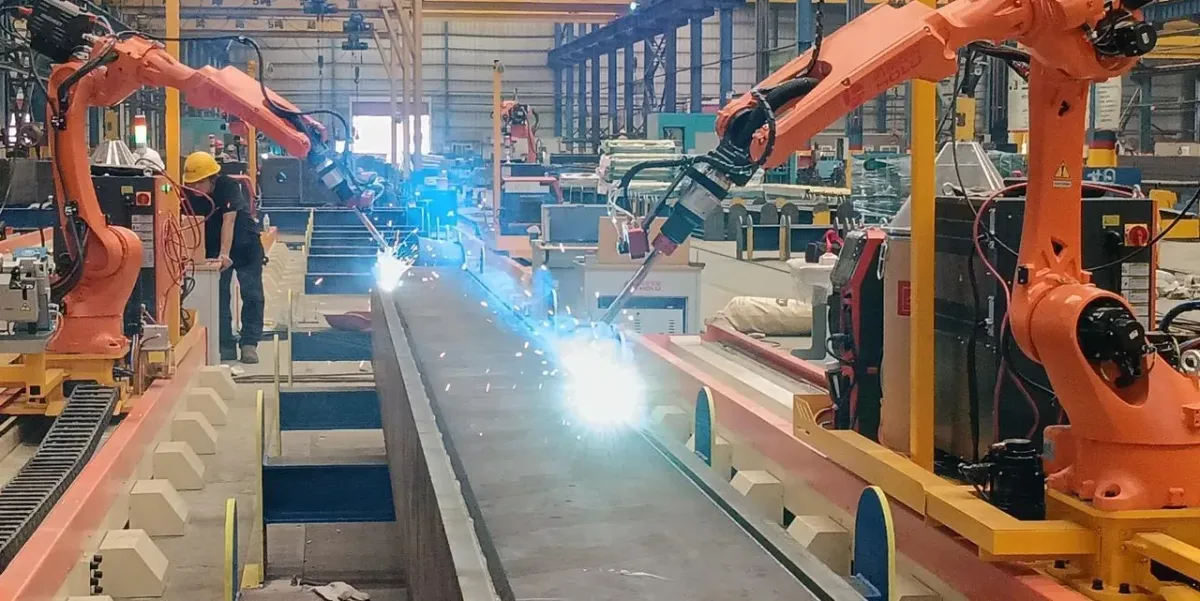
7-Axis Rail-Mounted Welding Robot
For H-beams, columns, crane runway beams and curved beams, with their stiffeners, corbels and cleats.
- Width ≤ 1,500 mm
- 12 m rail, 10.63 m travel
- STEP / IFC import
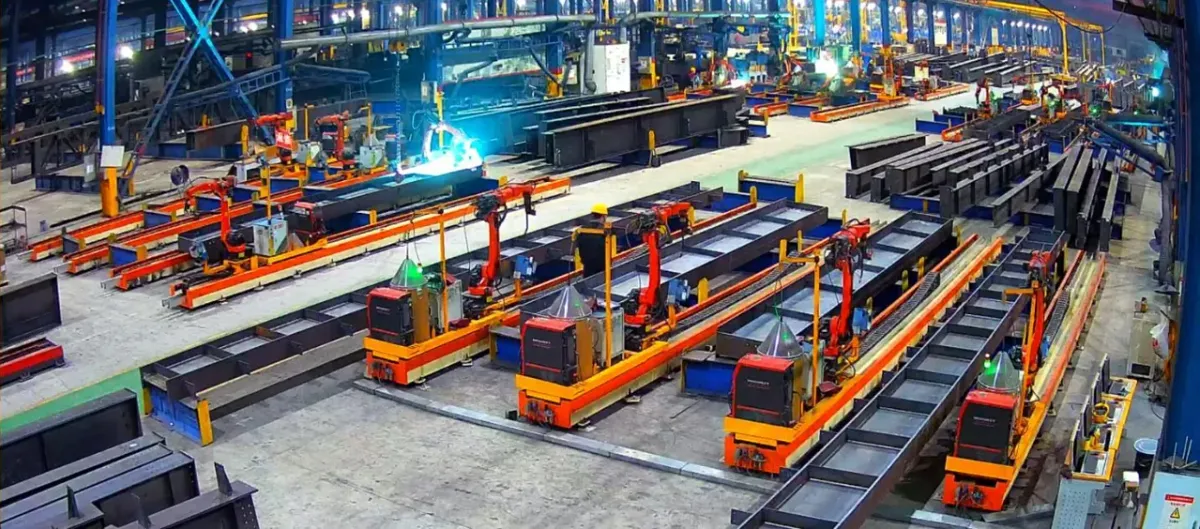
Welding robots for steel structures
Two main robotic welding systems cover most structural steel: a rail-mounted robot for beams and columns, and a cantilever robot for wide plates and bridge units. Both plan their own weld paths from your 3D model.
Factory-direct pricing from the manufacturer, and a free evaluation of your parts before you decide.
For H-beams, columns, crane runway beams and curved beams, with their stiffeners, corbels and cleats.
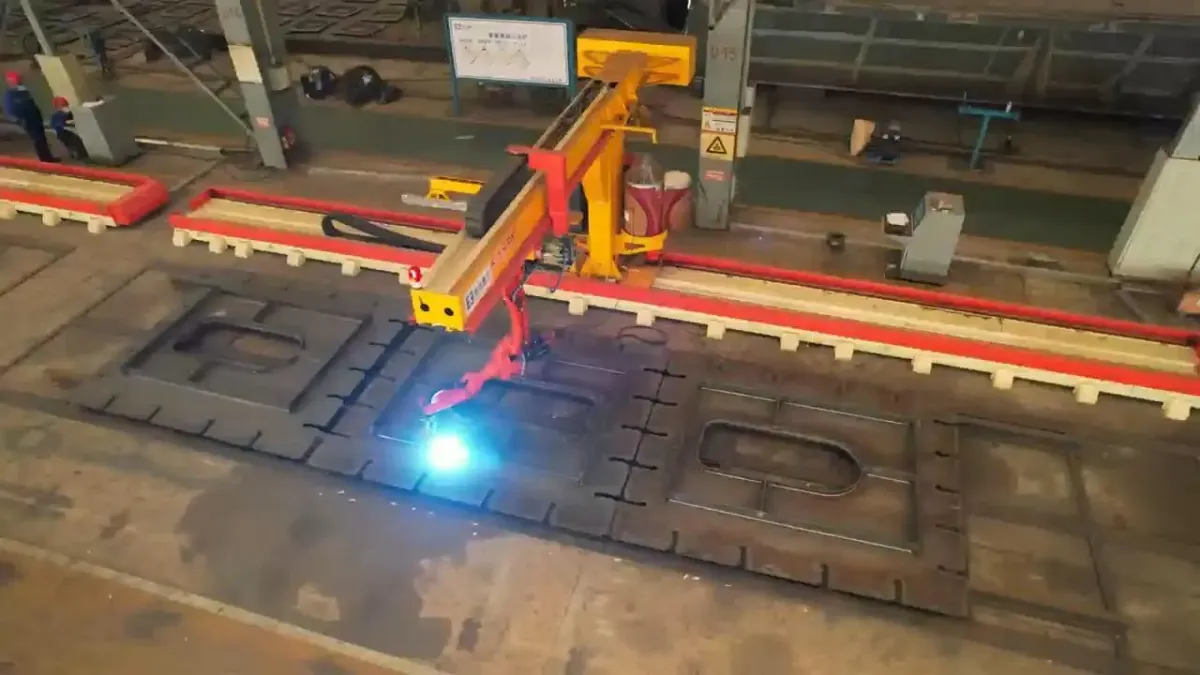
For bridge plate units, diaphragms and wide stiffened plates, welded from above.
| Compare | 7-Axis Rail-Mounted | 8-Axis Cantilever |
|---|---|---|
| Typical parts | H-beams, columns, crane runway beams, curved beams, corbels and cleats | Bridge plate units, diaphragms, stiffened and wide planar plates |
| Robot position | On a travelling ground-rail carriage beside the part | Suspended from a travelling cantilever above the part |
| Workpiece width | Up to 1,500 mm | Up to 3,500 mm |
| Effective travel (standard) | 10.63 m on a 12 m rail | 12 m on a 15 m frame |
| Programming | From a STEP/IFC model; scan-based for flat stiffened plates | From a STEP/IFC model; scan-based or parametric without drawings |
| Staffing | One operator runs 3–6 stations | One operator runs 3–6 stations |
Start from the parts you weld most. If they fall into more than one group, send us a typical part of each.
Beams and columns
Long members up to 1,500 mm wide, welded from the side and from above.
Wide plates and bridge units
Flat assemblies up to 3,500 mm wide, welded across the full width from above.
Box columns, full-penetration seams
Root, fill and cap passes on box columns and H-sections, with seam tracking.
Not sure yet
Send a drawing, model or photo. Our engineers recommend a system and quote it.
Compare rail-mounted, cantilever and gantry layoutsOther welding robot systems6, 7, 8 or 9 axes: which do you need?Submerged arc welding robotBeam and column weldingBridge steel weldingPEB steel building welding
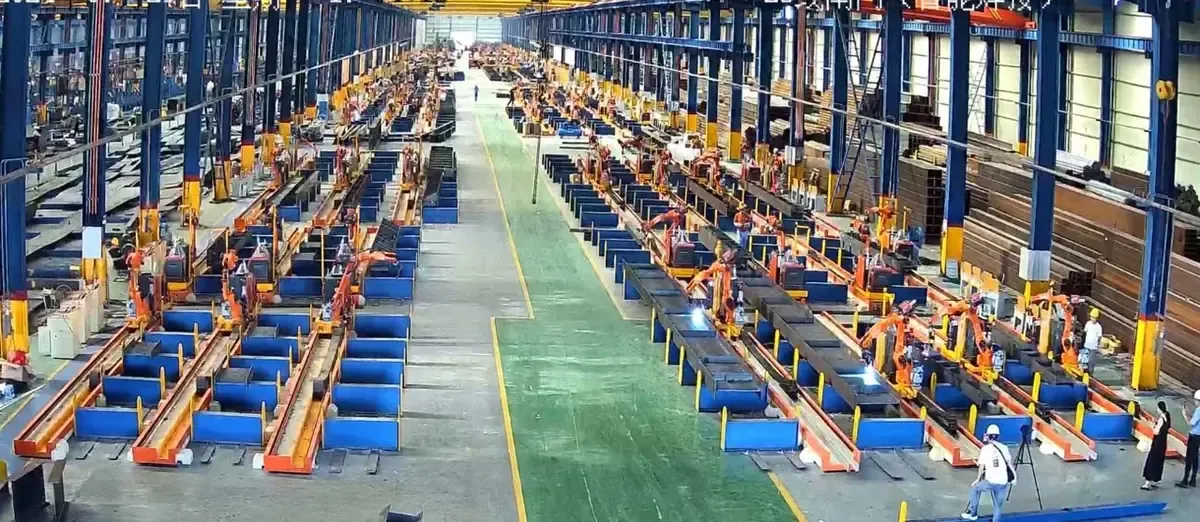
You can start with one robotic welding station and add more as your volume grows. In our parent company’s plants, rows of rail-mounted and cantilever stations form complete steel structure welding lines.
A robot on a fixed base, for parts you can bring to the station. Send us the part and we plan how it is positioned so the torch can reach each joint.
Ask about this systemA compact welding robot that travels on the workpiece itself, for long seams on large components that cannot easily be brought to a fixed station.
Ask about this systemOne or more robots hang from a gantry over the work area, for parts that are best welded from above. Send us the part and we propose the gantry size and the number of robots.
Ask about this systemA compact robot and its welding equipment on one trolley, taken to large or awkward parts that cannot come to a station.
Ask about this systemA 7-axis cantilever welding robot for steel structures: the robot hangs upside down from a cantilever that travels along the station and welds parts from above.
A simpler overhead layout for parts that need an approach from above but not the full reach of the 8-axis station.
Ask about this systemAn inverted cantilever layout that moves the robot along a 9 m rail, 2.5 m across and 2.5 m up and down (standard), for three-dimensional frames and box structures such as equipment frames and transformer tanks.
It also suits parts without drawings: a large line scanner captures the part for reverse modelling.
See the 9-axis cantilever robotA rail-mounted station with a 50 kg-payload robot and a 1,250 A submerged arc power source, for full-penetration root, fill and cap passes on box columns and H-sections. Single-wire and twin-wire versions.
Real-time seam tracking; 12 m rail with 10 m effective travel (standard); model import or reverse modelling.
Ask about this systemWhen none of the standard layouts fits your parts, we build the station around them: travel range, number of robots and mounting are adapted to the job.
Send a drawing or photo of the part and the welds, and our engineers propose a layout.
Ask about this systemSend one typical part — a drawing, model or photo — and mark the welds you want to automate. If your parts differ a lot, send one of each type.
We check torch access, supports and loading together. These decide the layout, not the rail length or the number of axes.
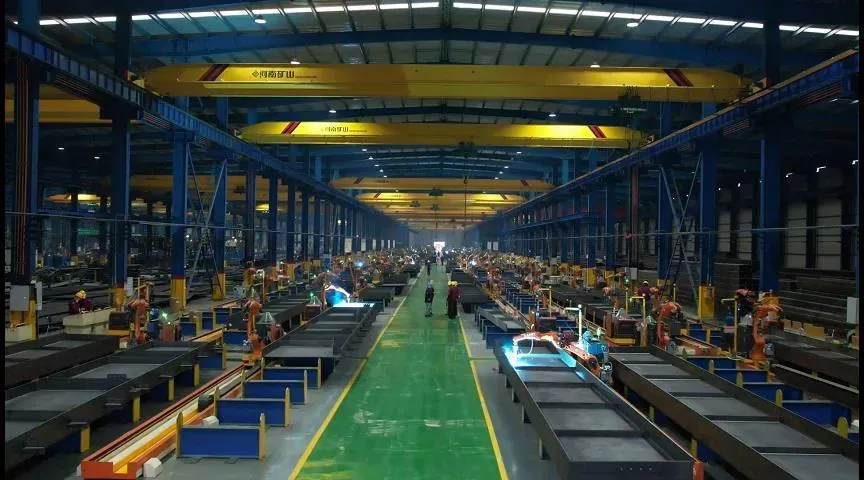
Both main systems are teachless: import a STEP or IFC model and the software finds the welds, plans the path and checks it for collisions. Flat stiffened plates can also be scanned at the station when there is no drawing.
Operators load parts and start jobs rather than programming the robot, and learn to run the station in 1–5 days.
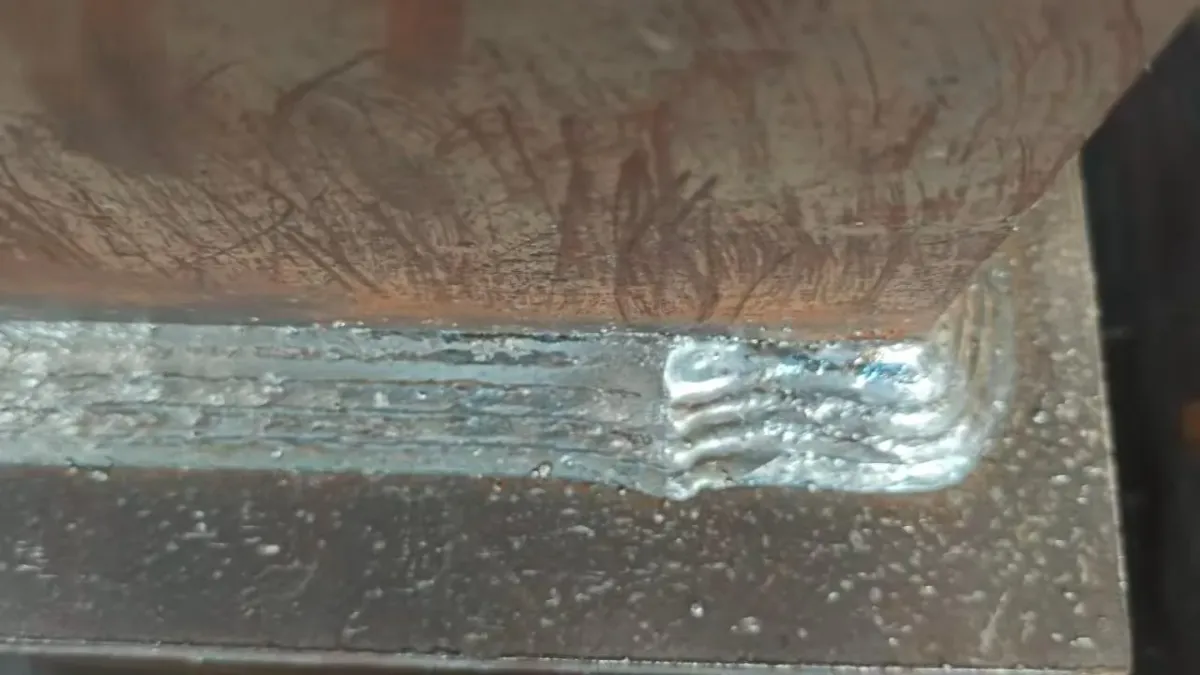
Send a drawing, model or photo of a typical part. Our engineers recommend a system and prepare a factory-direct quotation — free of charge. We reply within one business day.
Or email sales@steelweldingrobot.com