
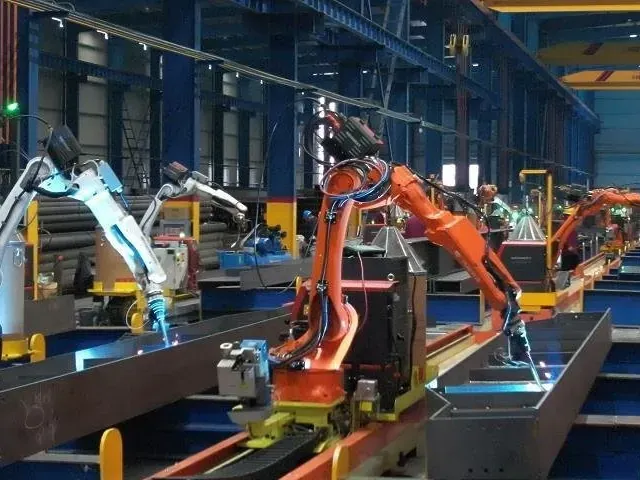
Steel fabrication workflow
H-Beam Welding Line: What the Gantry Welds and What a Robot Welds
An H-beam welding line takes cut plates through assembly, main seam welding, straightening, fitting assembly and fitting welding before finishing. An automatic beam welding machine usually concentrates on the long flange-to-web seams. Stiffeners, end plates and brackets introduce many short welds after that main operation.
Plan the equipment around those different joints. Our gas-shielded robots take the fitting welds, while our submerged arc station takes full-penetration root, fill and cap passes on box columns and H-beams.
The Operations in an H-Beam Welding Line
This sequence describes common fabrication operations. The right arrangement starts with your member families and the welds they need, including what is already automated and what your welders still do by hand.
| Operation | Common equipment | Our station |
|---|---|---|
| Cut plates | Plate cutting machine | — |
| Assemble the H-section | H-beam assembly machine | — |
| Weld the main seams | Gantry submerged arc welder | — |
| Straighten | Flange straightening machine | — |
| Fit stiffeners, end plates and cleats | Assembly benches and fixtures | — |
| Weld the fittings | Manual gas-shielded welding | 7-axis rail-mounted welding robot |
| Full-penetration joints | Submerged arc welding | Submerged arc welding robot station |
| Finish and handle | Cranes, conveyors and painting | — |
Our stations take over at the fitting-welding stage and for full-penetration seams. The operations before them decide how members arrive at the robot, so plan loading and supports together with the rest of the line.
Gantry Welder and Robot: Different Jobs
A traditional H-beam welding machine follows the long flange-to-web seams of a straight member. A robot moves its torch between different joints on the assembled part. This makes the fitting stage a separate decision from your existing main seam equipment.
See the beam and column weld table7-axis robot for H-beams and fittings
| Compare | H-beam gantry welder | Gas-shielded robot station |
|---|---|---|
| Welds | Long flange-to-web seams of straight beams | Stiffeners, end plates, corbels, cleats and accessible web-to-flange fillets |
| Parts | Straight H-beams before fittings are added | Assembled beams, columns and crane runway beams with fittings |
| Programming | Set up for the main seam of each beam | Imports the STEP / IFC model; the software finds the welds, plans paths and checks collisions |
| Weld types | Continuous main seams | Straight, polyline, curved and vertical-down fillets; lap and wrap-around welds; intermittent welds on straight seams |
Put Full-Penetration Joints in the Right Operation
Full-penetration seams need a different welding plan from the fillets on cleats and stiffeners. Our submerged arc robot station welds root, fill and cap passes on box columns and H-beams, following the joint with real-time seam tracking. Single-wire and twin-wire versions are available.
Flange and web splice butt joints are a distinct task. These full-penetration joints are usually welded with a submerged arc tractor. Include joint preparation, plate thickness and the required passes when you send parts for evaluation.
Build the Robot Stage Around Your Members
For long H-shaped members, a 7-axis robot travels beside the part on a ground rail. Two robots can share one rail for long components. Wide planar parts and bridge plate units suit the 8-axis cantilever layout, which approaches the welds from above.
Begin with the part, then plan supports, loading and removal. The longest member is only one input: fittings near the end of a beam and crowded joints also affect the working space. A model lets the software check the planned paths for collisions.
- H-shaped members and fittings: start with the 7-axis rail-mounted station.
- Wide planar plate assemblies: review the 8-axis cantilever station.
- Full-penetration seams: review the submerged arc station.
- Mixed production: send a typical part from each family and identify the welds to automate.
Compare rail-mounted, cantilever and gantry layoutsPlan loading and workshop spaceCompare all our welding robot systemsPEB columns, rafters and fittings
H-Beam Welding Line Questions
Use the joint list and your current production sequence to answer these questions.
Is a welding robot an H-beam welder?
It can weld H-beams, but its role differs from a gantry main seam welder. The rail-mounted robot handles joints on the assembled member, including the fittings added after the main seams have been welded.
Can the robot weld between the flange and web?
Yes, where the torch can reach: the 7-axis robot welds web-to-flange fillet welds in the flat and horizontal positions. A full-penetration splice is a different joint and belongs in the submerged arc plan.
Do we still need a robot if we have a gantry welder?
Look at the work left after the main seams: fitting assembly and welding. If stiffeners, end plates, cleats and brackets are still welded by hand, those are the joints to include in a robot evaluation.
How many robots should a line have?
Choose from the part mix and the weld volume you want to automate. Send member sizes, weld details and monthly production so our engineers can assess the layout. You can begin with one station and add more as volume grows.
What should we prepare for the evaluation?
Send drawings, STEP or IFC models, or photos of typical members, with weld symbols, dimensions and the joints that take most manual work. Include your existing equipment and the space available for loading and removal.
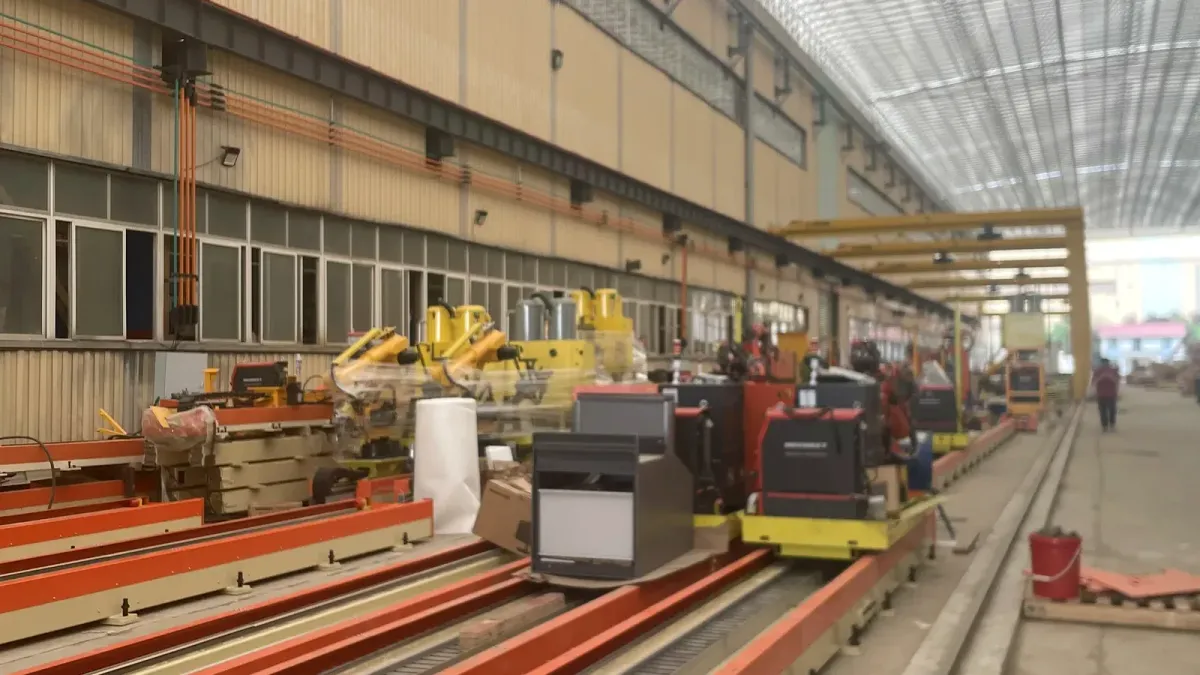
Plan the Welding Stage for Your Parts
Send your member drawings and tell us which welds you want to automate. Our engineers review the parts for free and recommend the robot station that fits your production. We reply within one business day.